On demonyms and ways of referring to oneself.
There are many haters who despise the European Union and claim that calling citizens of the European Union «Europeans» is incorrect under any circunstance because there are more Europeans who are not citizens of the Union (when, hypocritically, they have never called themselves «Europeans» in their miserable lives).
I have bad news for them.
Since May 1, 2004, the demonym «European» is OFFICIALLY, and in international legal and geopolitical terms (for example, UN statistics) and even in terms of linguistic definition, synonymous (through metonimy or sinecdoche) with «citizen of the European Union» (Europe with European Union, etc.), given that the Union encompasses the majority of the continent’s population and due to other legal details, such as being the first supranational entity to adopt the name and the corresponding demonym (the word used to denote a person who inhabits or is native to a particular place).
In English:
adjective: European
relating to or characteristic of Europe or its inhabitants.
«twentieth-century European art»
relating to the European Union.
«a single European currency»
noun
noun: European; plural noun: Europeans
a native or inhabitant of Europe.
a national of a state belonging to the European Union.
a person who is committed to the European Union.
«they claimed to be the party of good Europeans»
a person of European parentage or descent.
Oxford Dictionary.
In other languages like Spanish:
In Spanish:
«European» can refer to both the geographical/continental entity and the European Union in contemporary contexts, according to the Pan-Hispanic Dictionary of Legal Spanish.
It is the context that decides when we are referring to the physical geographical entity or the political one.
So yes, it is ABSOLUTELY correct and even legal to refer to the European Union as «Europe» and to its citizens as «Europeans» in the right CONTEXT. Period.
So no, not anymore some know-it-all can’t just come up to you and tell you in the middle of a conversation about geopolitics, the European GDP growth or similar that you can’t use the word Europe to refer to the European Union. YOU CAN AND YOU SHOULD.
Moreover, the use of «Europe» to refer to the European Union has become so commonplace that it’s now colloquial and everyday language. So much so, that even the EU’s enemies (some of them in the same continent!) frequently refer to the EU as Europe.
Hahaha…
.
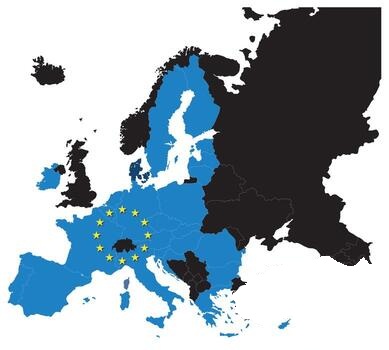
So if someone comes at you with a big mouth asking why a map of statistics about Europe shows Spain and the EU members but not Russia, which is also in the European continent, just shove the definitions right in their face.
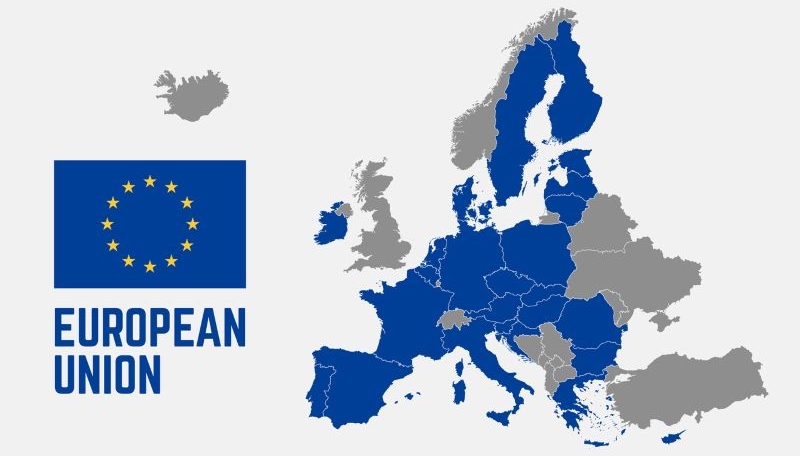
The same applies to other supranational entities that encompass the MAJORITY of the population of a defined physical region. Another example is the African Union.
To put it more clearly and avoid confusion: a German is European by virtue of being from the European continent and is a European citizen. A Belarusian can say of himself that he is a continental European but CANNOT call himself a «European citizen» (in fact, it would be illegal to claim such a thing in certain legal jurisdictions because it is a LEGAL term).
That’s how things are, and that’s how new identities emerge. Because yes, things evolve. In Politics an Linguistics, too. What you believed to be true yesterday may change to accommodate new realities.
.
If tomorrow a similar supranational entity were to emerge that encompassed the majority of the population of, I don’t know… Asia, its members would also have the right to consider their demonym as legally and politically the only one. That is, «Asian» would be both someone born in Asia and a citizen of a supranational entity with a majority in that region bearing that name.
.
To put this in perspective, let’s look at other similar cases.
One example is the term Afrikaans or Afrikaner, which many Boers use to refer to themselves because they don’t want to use the term «Boer» due to its negative historical connotations. Many Black South Africans complain about the use of these terms, which mean «African,» because it would also refer to them. It is generally understood that «Afrikaans» refers to someone who uses the language descended from Dutch in South Africa regardless of the color of their skin, but some still complain.
Another example is the use of «America» by the United States of America. For many Spanish speakers, it is incorrect that the USA (in fact, in Spain we refer to them with the demonym «estadounidense«) has appropriated the term «America» and the demonym «americano» to designate their country and their demonym because we understand that «America» is the continent (whether North America or South America, in fact, in Spanish we say «las Américas») and that a US citizen born in Ohio is just as American as a Costa Rican from San José or an Argentinian from Ushuaia.
But it is true that given:
1. That the United States was the first to officially designate itself with the term «Americans» as an independent political demonym, and…
2. That they have used it systematically and…
3. Constituting the most populous country on the continent (numbers also grant legal precedence, too)…
That, legally, that is, in the realm of International Law and Political Science, they have ample right to use both (noun and adjective) to refer to themselves and their country. A Guatemalan is American by virtue of having been born on the American continent, but he/she is not an «American citizen».
Just as in the European case, it is the CONTEXT that determines when we are talking about continents and their inhabitants or about political entities and their citizens.
So stop splitting hairs and get used to these changes in (geo)political definitions and adjectives because this is increasingly the norm.
Even the adjective «Atlantic» is starting to be used to refer to a possible union of Canada and the European Union.
.
Your typical proPutin Russian:
-I don’t agree!
Any decent EUROPEAN:
-Fuck you.


Debe estar conectado para enviar un comentario.